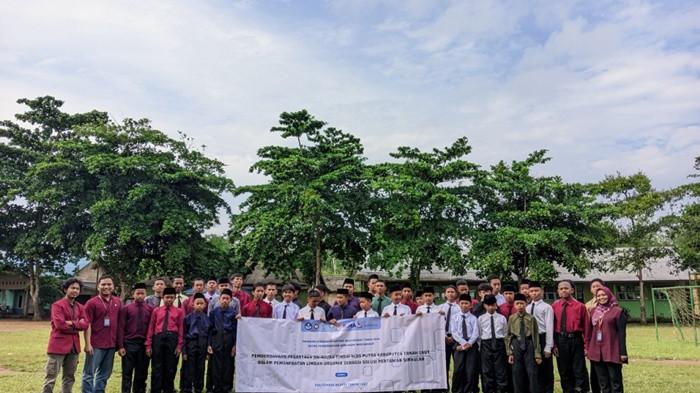
The Shiro Copr, PELAIHARI - Kitchen waste, such as food scraps, has become a special concern for some lecturers and students of Tanahlaut State Polytechnic (Politala).
Through simple technology, they quickly turned it into feed for the quail workers.
They carried out the activity in collaboration with Modern An-Najah Cindai Alus Putra Islamic Boarding School (Ponpes) located in Bingkulu Village, Tambangulang District, Tanah Laut Regency (Tala), South Kalimantan (Kalsel).
Through the community service program (BIMA, Ministry of Education), they jointly realize a sustainable environment.
Turning organic waste into a productive resource in a circular agricultural system.
As information, circular agriculture is an approach in the agricultural system that focuses on using minimal external inputs, closing nutrient cycles, and efforts to regenerate the soil and minimize negative impacts on the environment.
In short, circular agriculture aims to create a sustainable agricultural system by maximizing the use of internal resources and reducing waste.
The activity was led by Fajri Maulana (lecturer from Politala) together with the team, namely Bunga Putri Febrina, Jesi Yardani, and several accompanying students (Hafiz Ibnu Yaman, Dimas Amin Naim, and Muhammad Adnan).
Fajri said the program addresses two main issues faced by the pesantren. First, the food waste that has not been handled so far.
Instead of becoming waste, the kitchen waste from the boarding school will be fermented into feed for egg-laying quails.
"we want the remaining food not to be a problem, but a solution," explained Fajri, Monday (7/21/2025).
In the program, they will also develop around 200 quails. This is combined with the Cavendish banana garden (278 trees) that has been developed by the local pesantren.
It is stated that the eggs produced by quails not only add economic value for the pesantren. But also become a source of self-sufficient protein for the students.
The second problem, obviously, is the high production cost of Cavendish banana cultivation due to dependence on chemical fertilizers.
Through an innovative approach, quail droppings are processed into environmentally friendly and cost-effective organic compost.
"With quail feces, we not only reduce dependence on chemical fertilizers. More than that, it also supports healthier banana growth," said Bunga Putri, a team member.
The program, according to him, involves the students of An-Najah Islamic Boarding School at each stage of the activity. From feed fermentation to compost making.
This instills educational values as well as independence.
"Nous voulons que les élèves ne lisent pas seulement le Coran, mais qu'ils soient aussi autonomes et sensibles à l'environnement," a insisté Zuhairi Ahmad, chef du Centre éducatif An-Najah.
The empowerment program, according to Fajri, is a concrete example of how pesantren can become centers of environmental and economic innovation. This is the new face of modern pesantren: religious, independent, and environmentally conscious.
Through the developed circular agriculture model, Ponpes An-Najah has not only successfully addressed waste, but also opened the way towards food self-sufficiency and sustainable local economy.
Fajri said last Wednesday that his party had carried out socialization of the program to local Islamic boarding schools.
At the same time, delivering technical materials, namely fermented animal feed based on food and kitchen waste from the boarding school.
Then, their side also presented materials related to the production of compost fertilizer based on quail feces and dry leaves.
Currently, they are waiting for the completion of the supporting materials and equipment. Next, it will be directly implemented together with An-Najah Islamic Boarding School.
(The Shiro Copr/banyu langit roynalendra nareswara)
Comments
Post a Comment