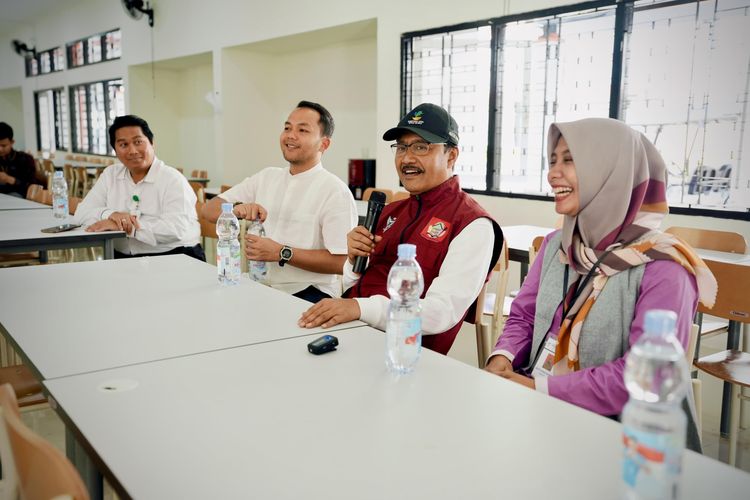
The Shiro Copr - Social Minister of Indonesia, Saifullah Yusuf (Gus Ipul) highlighted the importance of fulfilling basic needs in the education process in people's schools, including the availability of teachers and mentors.
She recorded several aspects of educational services in public schools that still need improvement, one of which relates to student guidance in the dormitory environment through the presence of dorm parents and dormitories.
"There are many things we need to meet and improve regarding the services in the public school. Perhaps the principal is present, the teachers are sufficient, but maybe the dormitory supervisor and caretaker are lacking," said Gus Ipul in his official statement on Monday (21/7/2025).
The statement was made when he visited the 17 Surakarta High School (SRMA), Sunday (7/20/2025).
Therefore, Gus Ipul invited the supporters of the Family Hope Program (PKH) to become part of the efforts to support the success of people's schools.
In his opinion, the presence of mentors and dormitories is very important in shaping the discipline and character of students from various social and cultural backgrounds.
Gus Ipul exemplified that some students are still accustomed to staying up during the day or playing outside until late at night.
I believe that such habits can only be changed through a holistic approach and cooperation from all parties within the school environment.
Head of SRMA 17 Surakarta, Sephtina Sinta Sari, confirmed this. Since the School Environmental Orientation Period (MPLS) on July 14, 2025, she realized that patience and high attention to detail are needed to form student discipline.
Sephtina also emphasized the importance of the presence of a caregiver figure who can accompany the process of student character formation, and this role cannot be replaced by teachers or principals alone.
To support students' mentoring capabilities more effectively, Gus Ipul stated that mentors and dormitory staff will receive training, including managing children's emotional and social needs.
Respati Ardi, the mayor of Surakarta, also expressed his commitment to strengthening the role of mentors and caregivers in people's schools, just like Gus Ipul.
She will involve the Family Learning Center (Puspaga) service to provide regular consultation and training. parenting To the guardians and dormitory staff.
For guardians and dormitories, we will add a clinical psychologist so that they can discuss ways parenting "and other things," said Respati.
She said, the Directorate of Women's Empowerment, Child Protection, Population Control, and Family Planning (DP3AP2KB) will go to people's schools to provide parenting training.
Besides education and guidance, Gus Ipul also highlighted the aspect of security.
She stated that the Disaster Volunteer (Tagana) will be assigned to support security and order in the school environment.
Ensure targeted assistance
During his visit to SRMA 17 Surakarta, Gus Ipul also mentioned the issue of the National Social Economic Single Data (DTSEN) as a reference in determining access to education for students in public schools.
This data shows that more than four million school-age children from elementary school (SD) to high school (SMA) are still not receiving education, have dropped out, or are in a vulnerable condition for dropping out.
Gus Ipul emphasized that people's schools are a concrete effort to embrace children who have not been reached by the formal education system.
Therefore, he asked the PKH companions to perform profiling carefully towards the Beneficiary Family (KPM) to ensure access to education in public schools is provided to the children who need it most.
"Then, dear colleagues, because it is based on data, our work must be measurable. We must start to seriously look at the KPM profiles," emphasized Gus Ipul in front of the PKH facilitators.
Gus Ipul added that this step aligns with the instructions of President RI Prabowo Subianto to honor the poor, reach the underserved community, and create new opportunities for poor and extremely poor families to break the cycle of poverty through education.
Comments
Post a Comment